
KPEYEZ
Company
Vaco
Role
Lead UX and UI Designer
Year
2025

OVerview
KPEYEZ is a SaaS analytics platform built for multifamily property management teams, including leasing agents, regional managers, and asset managers. The product consolidates operational and revenue data into a single system, supporting decisions around occupancy, funnel performance, and portfolio health.
The Challenge
The challenge was designing analytics that served multiple user roles with competing priorities, while keeping the system understandable and actionable for day-to-day use.
The platform needed to support users with very different mental models and decision timelines:
-
Leasing agents needed quick, tactical insights to act on leads and occupancy
-
Regional managers needed cross-property comparisons and trend visibility
-
Asset managers needed high-level performance signals tied to revenue outcomes
At the same time, the data itself was complex—spanning funnels, occupancy, and financial performance—and risked overwhelming users if presented without clear hierarchy.
My role
I led end-to-end product design for KPEYEZ, from early product definition through dashboard design and systemization.
My responsibilities included:
-
Defining dashboard structures and information hierarchy
-
Designing role-specific analytics views
-
Building a scalable design system aligned with MUI tokens
-
Partnering with engineering and business stakeholders to align product direction with real user needs
Approach & Focus
Interviews and workflow reviews revealed that a single analytics view could not support all user roles effectively. For example, regional managers could see portfolio-wide occupancy trends but struggled to quickly identify which properties were driving changes or how local context influenced performance. I used early flows and wireframes to clarify intent and hierarchy first, then iterated toward role-specific dashboards that emphasized actionable signals over data density.
Key Design Priorities
Role-specific dashboards tailored to each user’s decision scope, reducing cognitive load and increasing relevance
Action-oriented information hierarchy that prioritized signals users could act on over exhaustive reporting
Consistent patterns and systemization across dashboards, supporting learnability and long-term scalability
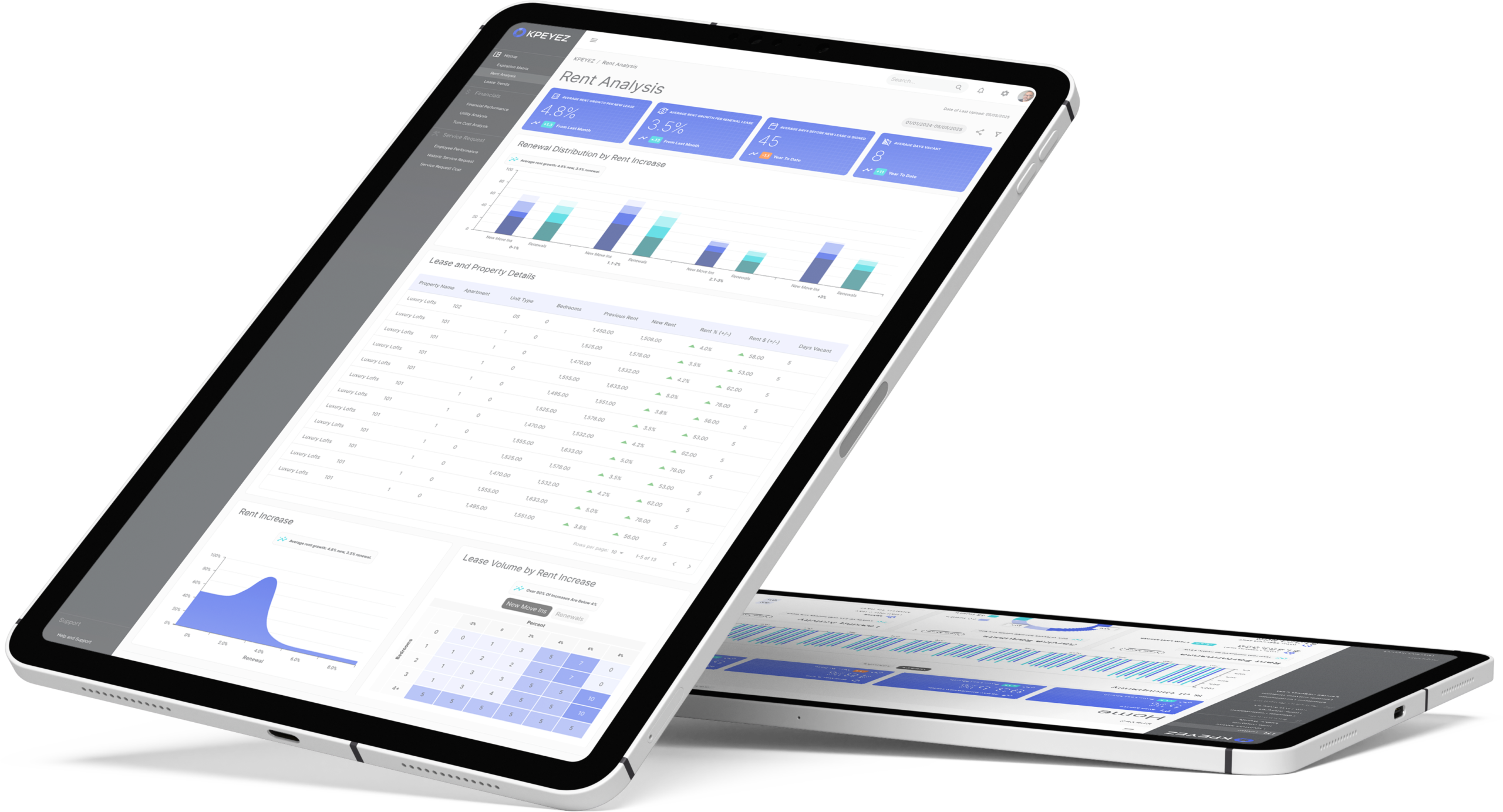
To address this, the dashboard was structured into distinct views—a home dashboard for portfolio signals, an expiration matrix to surface property-level risk, rent analysis for local pricing context, and lease trends to track change over time—allowing regional managers to move quickly from high-level trends to the underlying drivers.
Validation & Iteration
Early dashboard concepts were validated through stakeholder walkthroughs and scenario-based reviews, where users were asked to interpret trends and explain what actions they would take next. These sessions consistently surfaced confusion when portfolio signals and property-level drivers lived too close together, reinforcing the need for separated analytical views.
Iterative refinements focused on whether users could quickly answer core questions:
What is changing? Where is it happening? What should I look at next?
All without additional explanation. Feedback from these reviews directly informed how data was grouped, labeled, and sequenced across dashboards.
AI-Driven Insights
The team recognized early on that AI would be a key driver of modern analytics products and treated it as a foundational part of the experience rather than an add-on. AI was used to surface patterns, anomalies, and forward-looking signals within existing dashboards, helping users anticipate emerging risks and opportunities instead of relying solely on historical reporting. These insights were embedded directly into familiar workflows to support proactive decision-making while maintaining transparency, context, and user control.
Outcomes
-
Delivered a scalable analytics system supporting multiple user roles
-
Improved clarity and usability across data-heavy dashboards
-
Enabled stakeholders to reason more effectively about funnel performance and occupancy trends
-
Established a design system foundation aligned with engineering constraints, supporting future product growth
Tools & Methods
- Figma
- MUI-based design systems and component libraries
- Stakeholder collaboration and iterative design reviews